Most learning and development teams are measuring the wrong things — and the data makes it hard to ignore.
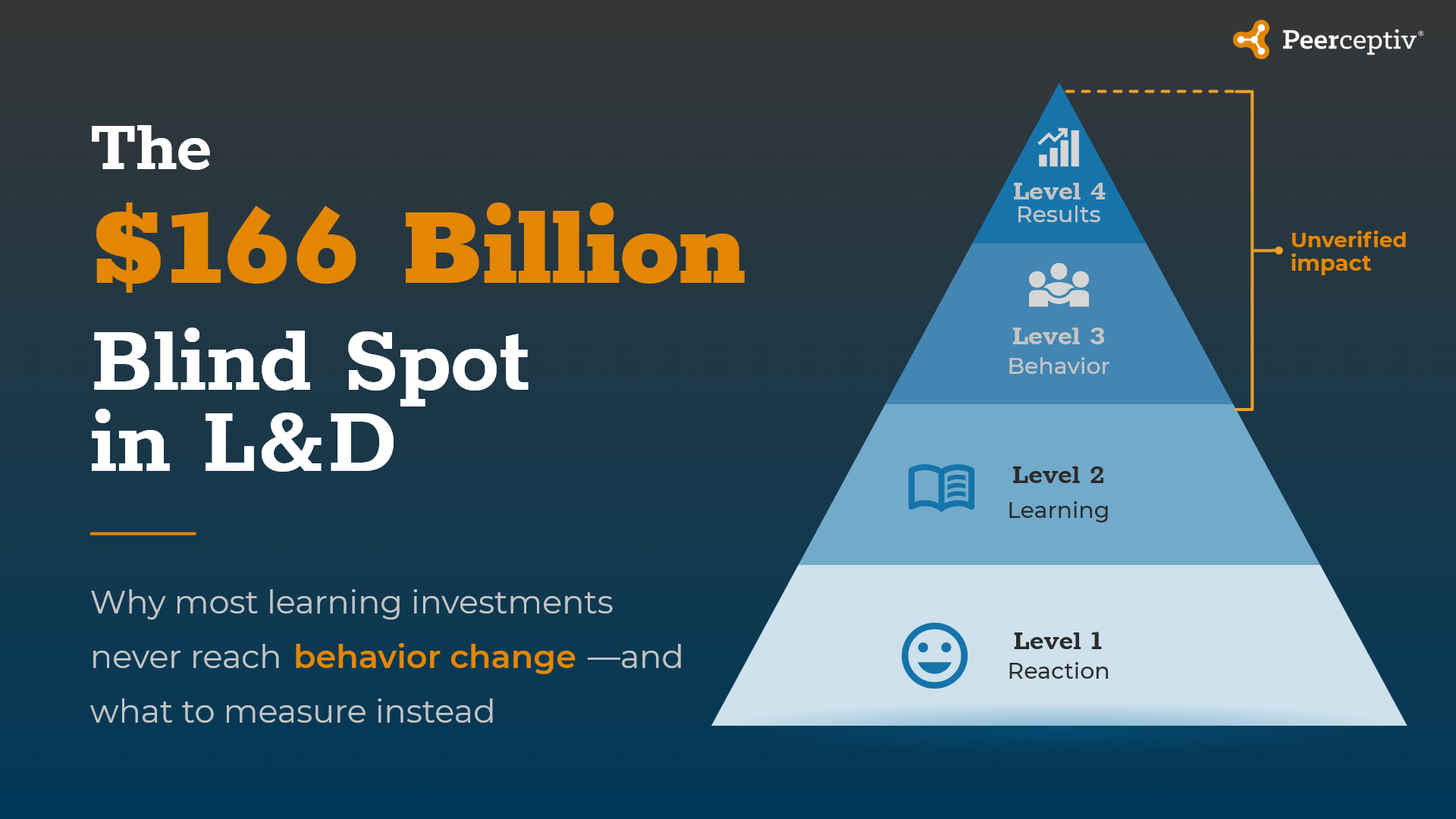
The Kirkpatrick Model has been the industry standard for evaluating training effectiveness for decades. It describes four levels of measurement: Reaction, Learning, Behavior, and Results. In theory, organizations climb the ladder. In practice, most organizations fall off a cliff between Level 2 and Level 3 — and never make it back up.
| 90–94% of orgs measure L1 Reaction | 7–10% reach L4 Results | <10% connect training to business outcomes |
What is the L&D Measurement Cliff?
Here's what Kirkpatrick adoption actually looks like across the industry:
| Level 1 90–94% Reaction
Did participants enjoy the program? Post-training surveys.
|
Level 2 60–70% Learning
Did they retain anything? Quizzes and knowledge checks.
|
| Level 3 18–20% Behavior
Are they applying skills on the job?
|
Level 4 7–10% Results
Did training impact business outcomes?
|
Source: Kirkpatrick Model industry benchmarks
The pattern is consistent everywhere: almost everyone measures whether people liked the training, most check whether they learned it, and then measurement collapses. Fewer than one in five organizations track whether behavior actually changed on the job, and fewer than 10% can connect training to a business outcome. The higher the level climbs toward real impact, the fewer organizations can see anything at all.
Why Do Most Teams Get Stuck At Level 2?
The gap isn't a motivation problem — it's an infrastructure problem. Measuring behavior change means observing people over time, across real work, with consistent criteria. Three barriers make this nearly impossible at scale:
Manager time constraints
Observing and documenting behavioral change requires sustained attention that most managers simply don't have. The observation never happens systematically, so the data never exists.
Subjectivity
Even when managers do observe, behavioral evaluation is inconsistent across raters and prone to bias. The same behavior gets rated differently depending on who's watching.
Cost and lag time
Comprehensive behavioral assessment is labor-intensive, which caps how far it can scale, and 360 reviews happen too infrequently to support timely decisions. The result: organizations invest heavily in development, then make promotion decisions on satisfaction scores and gut feel.
Despite significant investment in development programs, most organizations are making six-figure talent decisions without verifiable skill data. The Kirkpatrick model doesn't fail because the framework is wrong — it fails because measuring L3 and L4 requires infrastructure most teams don't have.
What Does Good Measurement Look Like at Each Level?
The difference between a team that's stuck and one that isn't comes down to a specific set of questions they can answer. Here's what mature measurement looks like level by level. If you can't answer the question on the right, that's where your gap is.
Level 1 — Reaction. Can you go beyond "did they like it?" Strong teams collect structured feedback in a standardized format across every program, and actually feed it back into program design, rather than filing satisfaction scores away.
Level 2 — Learning. Do you know they acquired the skill, and does it stick? Mature measurement assesses skill acquisition through something more than a one-time quiz, and reassesses after training ends to see whether the learning held.
Level 3 — Behavior. Can you name the specific on-the-job behaviors the training was meant to change, and tell whether they changed? This is the level almost everyone fails. It requires a formal check on behavior after training, active manager involvement, and a defined window in which to look, not a vague sense that "people seem better."
Level 4 — Results. Can you draw a direct line from a program to a measurable business outcome? Teams operating here have a methodology for calculating impact, and leadership that asks for the data, because the data exists to ask for.
Read those four questions honestly and most teams find they can answer Levels 1 and 2 and stall at 3. That stall is the measurement cliff, in practical terms.
What is Your Measurement Gap Costing You?
Before you can close the gap, you need to know exactly where your team sits. That's what the Kirkpatrick Measurement Maturity Scorecard is designed to reveal.
It's 13 questions across all four Kirkpatrick levels. It takes about five minutes. At the end, you get a maturity score by level — so you can see not just that a gap exists, but where it is and what it's costing you.
| Find Out Where Your Team Stands
A 13-question self-assessment across the 4 Kirkpatrick levels. See exactly where your measurement gaps are — and what they're costing you. Take the Free Assessment → |